

Holy Martyrs Adrian and Natalie

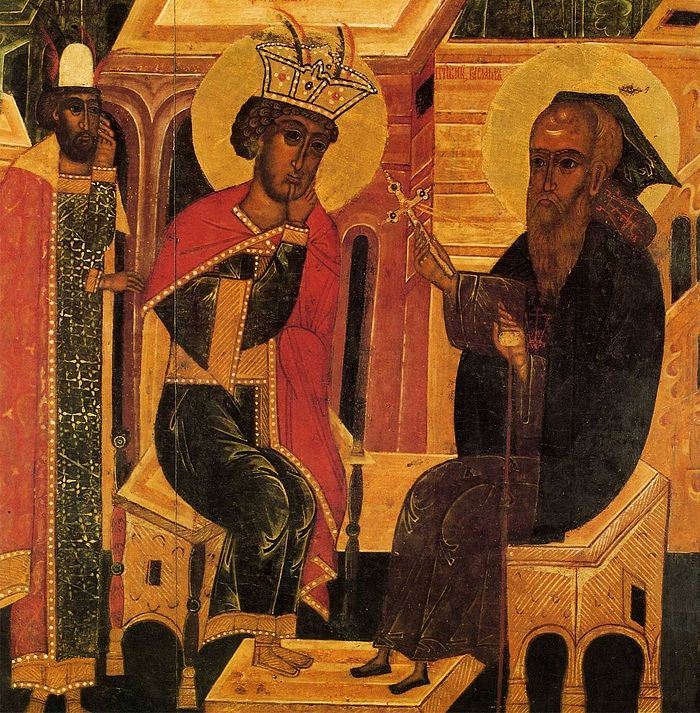
Adrian and Natalie were husband and wife, both of noble and wealthy families from Nicomedia. Adrian was the head of the Praetorium and a pagan and Natalia was secretly a Christian. Both were young and lived together in marriage for only thirteen months until martyrdom. When the nefarious Emperor Maximian visited Nicomedia, he ordered that Christians be seized and subjected to torture. In a cave near the city, twenty-three Christians were hidden. Someone reported them to the authorities and they were cruelly flogged with oxen whips and rods and then cast into prison. After that they were taken out of prison and brought before the Praetor to register their names. Adrian observed these people, tortured but patient, serene and meek and he made them swear to tell him what they expect from their God for so many tortures endured? They spoke to him concerning the blessedness of the righteous in the Kingdom of God. Hearing this and, again observing these people, Adrian, at once, turned to the scribe and said to him: "Write down my name with these saints, I also am a Christian." When the emperor learned of this, he asked Adrian: "Have you gone out of your mind?" To that Adrian replied: "I have not gone out of my mind but rather I came to my senses." Learning of this, Natalia greatly rejoiced and when Adrian, with the others, sat chained in prison, she came and administered to all of them. When they flogged and tortured her husband with various tortures, Natalia encouraged him to endure to the end. After lengthy tortures and imprisonment, the emperor ordered that an anvil be brought to prison and their legs and hands be broken with a hammer. This was carried out and Adrian, with twenty-three honorably men, gave up the spirit under the greatest of tortures. Natalia took their relics to Constantinople and honorably buried them there. After a few days, Adrian appeared to her all in light and beauty and called her, that, she also come to God and she peacefully gave up her spirit to God.

Hebrews 10:32-38 KJV
32 But call to remembrance the former days, in which, after ye were illuminated, ye endured a great fight of afflictions;
33 Partly, whilst ye were made a gazing stock both by reproaches and afflictions; and partly, whilst ye became companions of them that were so used.
34 For ye had compassion of me in my bonds, and took joyfully the spoiling of your goods, knowing in yourselves that ye have in heaven a better and an enduring substance.
35 Cast not away therefore your confidence, which hath great recompence of reward.
36 For ye have need of patience, that, after ye have done the will of God, ye might receive the promise.
37 For yet a little while, and he that shall come will come, and will not tarry.
38 Now the just shall live by faith: but if any man draw back, my soul shall have no pleasure in him.
Saint Mark 1:23-28 KJV
23 And there was in their synagogue a man with an unclean spirit; and he cried out,
24 Saying, Let us alone; what have we to do with thee, thou Jesus of Nazareth? art thou come to destroy us? I know thee who thou art, the Holy One of God.
25 And Jesus rebuked him, saying, Hold thy peace, and come out of him.
26 And when the unclean spirit had torn him, and cried with a loud voice, he came out of him.
27 And they were all amazed, insomuch that they questioned among themselves, saying, What thing is this? what new doctrine is this? for with authority commandeth he even the unclean spirits, and they do obey him.
28 And immediately his fame spread abroad throughout all the region round about Galilee.
Saint Ephrem the Syrian

H Y M N S O N P A R A D I S E
T H E T W O T R E E S
St. Ephrem, in common with a number of other early Christian writers, held the view that God created Adam and Eve in an intermediate state: if they kept the commandment not to eat the fruit of the Tree of Knowledge, then they would be rewarded by being allowed to eat it and thereby being able to progress to the Tree of Life, thus acquiring Divinity. In the event, however, their unthinking greed led them to break the commandment, and although they did thereby gain knowledge, it was only a knowledge of what they had lost by their disobedience.
In one of the Hymns on the Fast, St. Ephrem puts it as follows:
Who is there that can expound that Tree
which caused those who sought it to go astray?
It is an invisible target, hidden from the eyes,
which wearies those who shoot at it.
It is both the Tree of Knowledge, and of the opposite;
it is the cause of knowledge, for by it humanity knows
what was the gift that was lost
and the punishment that took its place.
Blessed is that Fruit which has mingled
a knowledge of the Tree of Life into mortals.
The knowledge imparted by the Tree of Knowledge is of an objective nature, but this knowledge can be experienced subjectively in totally different ways, depending on the attitude of the person who partakes of it. This extremely important insight is explored especially in the third of the Paradise hymns.


No comments:
Post a Comment